
Starting a Pétanque Club in Ireland
A Practical Guide from the Irish Pétanque Association
Pétanque is one of the simplest sports in the world to start playing. Starting a club, however, requires thought, structure and commitment. The good news is that it is entirely achievable. Clubs across Ireland have done it successfully, often beginning with nothing more than a small group of committed people and a shared vision.
This guide walks you through the key steps.
1. Deciding What Type of Club You Want to Be
Before laying a single boule, decide on your structure.
Unincorporated Association
Most new clubs start this way. It is simple and suitable for volunteer-run community clubs.
Pros
Easy to establish
Minimal administration
Flexible
Cons
Committee members may carry personal liability
This works well for early-stage clubs.
Company Limited by Guarantee (CLG)
Provides legal protection for officers and may suit clubs that:
Intend to lease land long term
Plan significant capital development
Apply for larger grants
Many clubs start simple and incorporate later if required.
2. How Many Members Do You Need?
Technically, very few.
Realistically:
5–8 committed people to form a committee
15–20 interested players to make it sustainable
Commitment matters more than numbers.
3. Governance – Constitution, Officers and Insurance
Constitution
Every club should adopt a written constitution covering:
Objectives
Membership
Committee roles
AGM procedures
Financial controls
Disciplinary procedures
Keep it practical and workable.
Officers
Minimum:
Chairperson
Secretary
Treasurer
Additional recommended roles:
Competition Secretary
Safeguarding Officer
PRO / Media Officer
Clear roles prevent burnout.
Insurance
Public liability insurance is essential.
Affiliation with the Irish Pétanque Association provides access to national insurance cover, which is particularly important when dealing with local authorities or operating on public land.
4. Affiliate with the Irish Pétanque Association
Every new club should affiliate with the IPA.
Affiliation provides:
Listing on the IPA website
Ability to publish opening times and club updates
Entry into IPA competitions
Access to national insurance cover
Insurance is crucial when:
Using public land
Negotiating with a County Council
Applying for grants
Partnering with another sports club
Affiliation strengthens both your club and the sport nationally.
5. Choosing the Right Location
Location determines long-term success.
Consider:
Parking
Toilets
Lighting
Shelter
Accessibility
Visibility
Clubs near existing amenities grow faster.
Suitable locations include:
Public parks
Rugby or GAA club grounds
Community centres
Disused sports facilities
Marina or harbour developments
6. Public Park, Existing Club or Private Land?
Each option has advantages.
Public Park
Visible and accessible
May involve planning permission
Existing Sports Club
Shared facilities
Requires agreement or licence
Private Land
Full control
Full responsibility
Engage early with landowners and local authorities.
7. Equipment You Will Need
Basic Equipment
Boules
Jacks
Throwing circles
Measuring tapes
Scoreboards
Rakes and maintenance tools
Recommended Suppliers
Start simple. Build gradually.
8. Building the Terrain
Before construction, read:
The Design and Building of a Pétanque Terrain (Edition 3, 2021) by Brian Forbes
Key principles:
Proper excavation and drainage are essential
Use crushed carboniferous limestone
Never use pea gravel
Follow the Golden Rule: never exceed 2.5 times stone size in layer depth
Drainage is critical in Irish conditions.
9. Example Construction Costs in Ireland
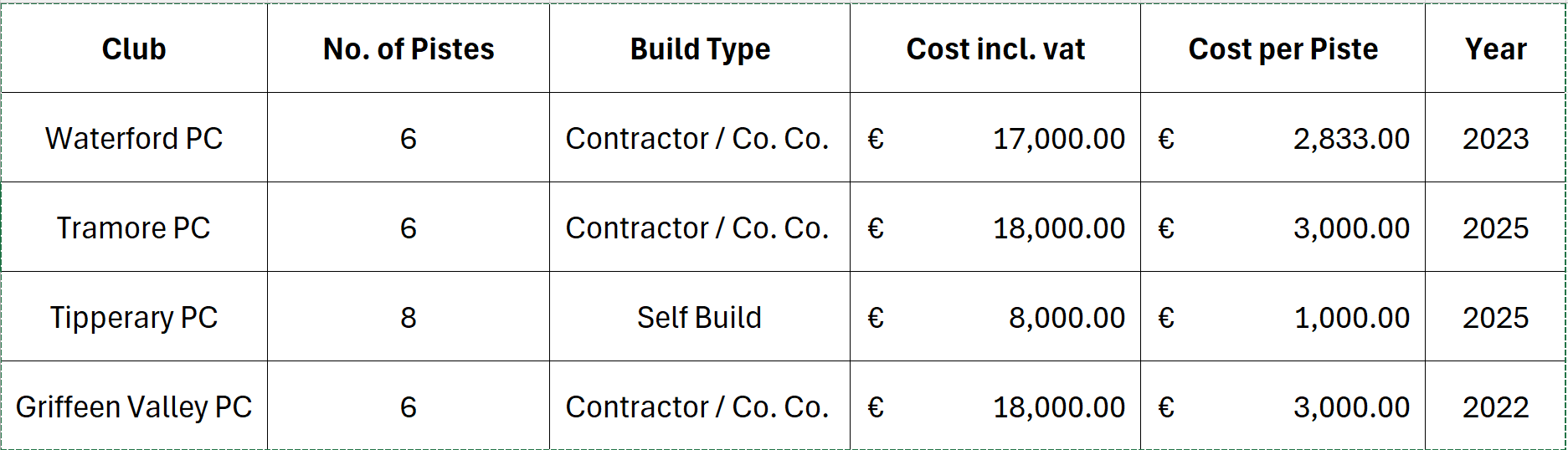
Contractors Used
Waterford PC
Tramore PC
Grifeen Valley PC
10. Grants and Funding
While Sports Ireland capital grants are not currently applicable to petanque club, many funding options exist:
County Council community grants
LEADER / Rural Development funding
Cultural and integration grants
Healthy Ireland initiatives
Local Area Partnership funding
Every club should join their local Public Participation Network (PPN):
11. Online Presence and Promotion
New clubs should create a Facebook page from the outset.
A Facebook page allows you to:
Promote playing times
Advertise open days
Share progress photos
Attract new members
Engage with the local community
Set up a Page, not a personal profile.
Consistency matters more than perfection.
A quiet page suggests a quiet club.
12. One-Page Club Start-Up Checklist
13. IPA Club Starter Pack